
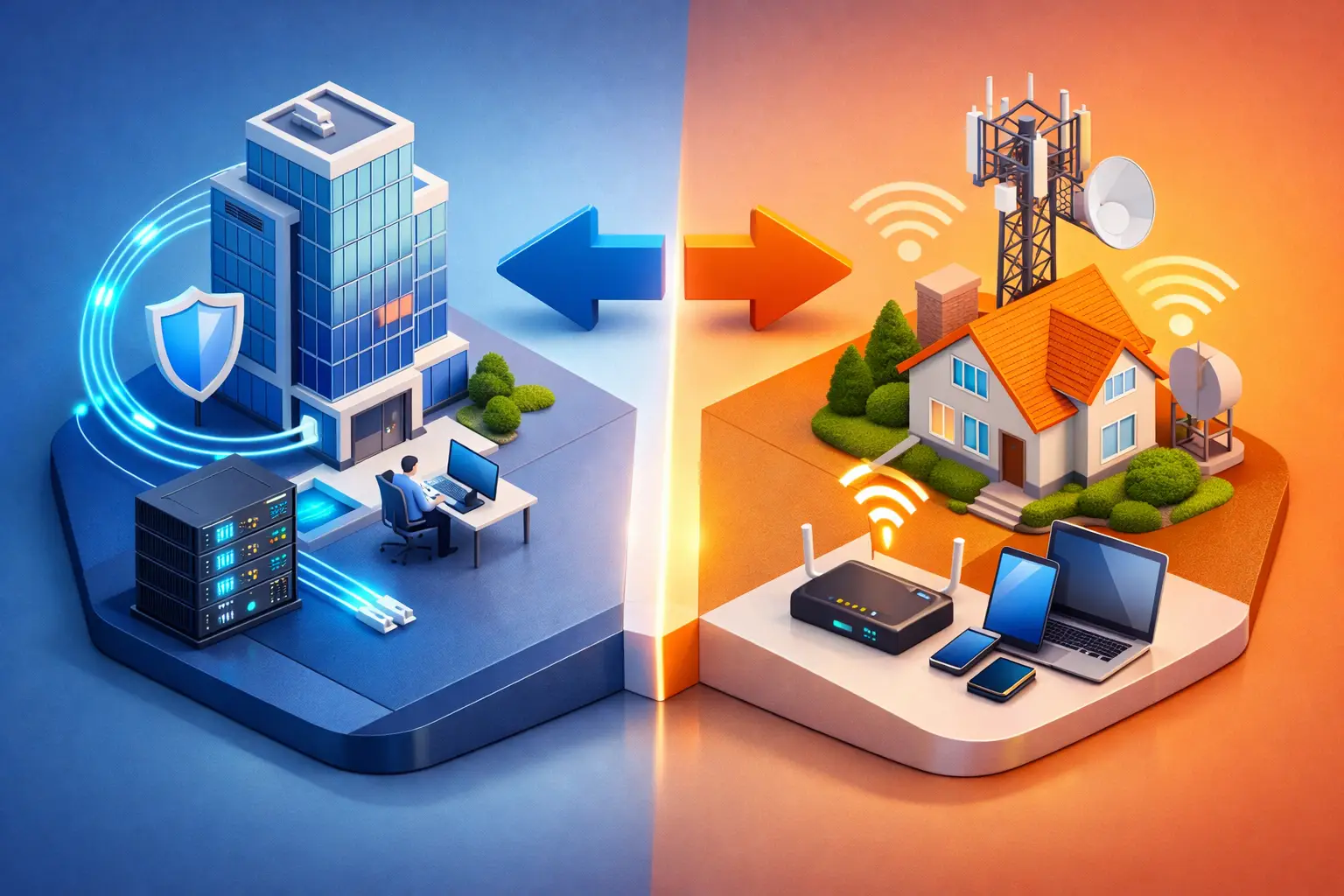
A video meeting freezes just as a customer is ready to sign off. The EFTPOS terminal drops out during the lunch rush. Your cloud files take minutes to open because the office upload is working overtime. These are the moments when the leased line vs broadband decision becomes more than a technical discussion – it becomes a question of business continuity.
For many Australian businesses, broadband is the sensible, cost-effective connection that keeps daily work moving. For others, particularly those running critical cloud systems, high call volumes or multiple sites, a leased line provides the certainty that shared internet services may not. The right choice depends on how your business uses connectivity, what downtime costs you and how much control you need.
What is business broadband?
Business broadband is an internet service delivered over shared network infrastructure. Depending on your address and available network, that may include NBN, OptiComm, fixed wireless, private fibre or satellite. It is designed to provide reliable connectivity at a far lower cost than a dedicated enterprise circuit.
The word “shared” does not mean poor quality. A well-chosen business broadband plan can comfortably support cloud applications, VoIP calls, online collaboration, remote access, EFTPOS, security cameras and everyday browsing. It is the practical choice for many small and mid-sized businesses, especially when paired with a business-grade modem, managed Wi-Fi and local support.
However, the available speed and performance can vary by technology, location, network demand and the quality of your on-site setup. A busy office using consumer-grade hardware, weak Wi-Fi or an undersized plan may experience issues that are not caused by the connection itself.
Broadband plans are often described by download and upload speeds. Download speed matters for receiving files, streaming and browsing, while upload speed has a direct impact on video calls, cloud backups, sending large files and hosting services from your premises. For businesses moving heavily to cloud platforms, upload capacity deserves as much attention as download speed.
What is a leased line?
A leased line is a dedicated data connection supplied for the exclusive use of one business. It is commonly delivered as enterprise ethernet over fibre and is built around agreed performance levels rather than best-effort access.
Unlike many broadband services, a leased line usually provides symmetrical bandwidth. That means a 100 Mbps service delivers up to 100 Mbps for both downloads and uploads. This is valuable for organisations sending large design files, running cloud backups, supporting many concurrent video meetings or connecting offices to central systems.
The defining feature is not simply speed. It is predictability. A leased line is normally supplied with a service level agreement, or SLA, covering targets such as fault response, restoration time, availability and performance. The exact commitments vary between services, so businesses should read the SLA rather than assume every dedicated service offers the same protections.
A leased line can also be configured to suit more complex networks. It may support private connectivity between sites, SD-WAN, managed firewalls, cloud environments and voice platforms where a stable connection is essential.
Leased line vs broadband: the key differences
The biggest difference between leased line vs broadband is the level of assurance. Broadband is generally a shared-access service with strong value and broad availability. A leased line is a dedicated service built for organisations where connectivity is central to operations.
Speed and upload performance
Broadband speed tiers can be more than adequate for a small office. A team of five using email, cloud accounting, web applications and occasional video calls may not need a dedicated circuit at all. The key is choosing a plan with enough upload capacity and ensuring the internal network can handle demand.
A leased line is better suited to sustained, high-volume traffic. Consider an architecture firm transferring large drawings, a medical practice using cloud imaging, a contact centre handling constant voice traffic or a business backing up terabytes of data. Symmetrical bandwidth prevents uploads from becoming a bottleneck while staff are trying to work.
Reliability and contention
All internet connections can be affected by physical damage, power issues, equipment faults and upstream network events. A leased line is not immune to outages. Its advantage is that it is designed with a dedicated access path and defined support commitments, which can reduce uncertainty when something goes wrong.
Broadband may be subject to greater variation at busy times or across shared parts of the network. For a business where a short slowdown is inconvenient but manageable, this trade-off is usually reasonable. For a site that loses revenue, operational visibility or customer service when the connection fails, the higher assurance of a leased line can be justified.
Cost and installation
Broadband is usually quicker and less expensive to deploy, particularly where a suitable NBN or fibre service is already active. It is a sensible way to connect a new office, a small retail site or a growing business that needs dependable internet without a major upfront commitment.
Leased lines cost more because they may require dedicated fibre construction, network engineering and enterprise-grade monitoring. Installation can take longer too, especially where new civil works, building access approvals or fibre extensions are required. Request a site assessment early if a dedicated connection is part of a relocation, development or expansion project.
Support and fault handling
When your internet is used for casual work, standard support arrangements may be enough. When every minute offline affects payments, phones, production or safety systems, support response matters just as much as the service speed.
Business broadband providers can offer responsive local assistance, but service restoration is often governed by the underlying access network’s processes. A leased line normally includes more specific fault management targets and escalation paths. That does not remove the need for a backup connection, but it gives IT teams and decision-makers a clearer operating framework.
When business broadband is the better choice
Broadband remains the right answer for a large share of Australian businesses. It offers strong performance for a predictable monthly cost and can be scaled as staff numbers or cloud usage increase.
Choose business broadband when your business can tolerate occasional variations in performance, your applications are not mission-critical at all times and your budget is better directed towards quality Wi-Fi, security or a secondary connection. A café, local retailer, professional services office, home-based business or small warehouse may be well served by the right NBN, OptiComm or fixed wireless plan.
The best setup is often not the fastest advertised plan. It is a connection matched to actual usage, supported by properly configured network equipment, separate staff and guest Wi-Fi, business phone prioritisation where needed, and an affordable mobile or fixed wireless failover option.
When a leased line makes commercial sense
A leased line is worth considering when your connection has become business-critical infrastructure rather than a utility. If staff cannot operate without access to cloud systems, phones, remote sites or customer platforms, the cost of interruption should be measured against the cost of a more assured service.
It is particularly relevant for multi-site organisations, businesses with heavy upload requirements, companies operating cloud PBX or SIP services at scale, developers, enterprises and organisations with compliance or security requirements. It can also suit regional projects where a purpose-built solution is the only practical way to achieve the capacity required.
Before committing, calculate the real cost of downtime. Include lost sales, idle staff, delayed dispatch, missed customer calls, emergency IT work and reputational damage. For some businesses, a few hours without internet costs more than the annual price difference between broadband and a dedicated circuit.
The strongest option may be both
This does not always have to be a choice between one connection or the other. Many organisations use a leased line as their primary service and business broadband, fixed wireless or mobile connectivity as an automatic backup. Others use broadband as the primary connection while retaining a secondary service for EFTPOS, phones and essential cloud access.
A dual-service approach should use different access paths where possible. Two services running through the same building entry point or relying on the same upstream infrastructure can still share a single point of failure. A proper assessment looks at physical route diversity, power protection, router configuration and how quickly failover occurs.
For businesses that need help matching access options with VoIP, managed security, SD-WAN or a continuity plan, InfiNET Broadband can assess the available services and build around the way your team actually works. The goal is not to buy enterprise infrastructure for its own sake. It is to make sure your connection supports the customers, systems and people who rely on it every day.
Start with the consequences of an outage, not a speed test result. Once you know what must keep running, the right connection becomes much easier to choose.