
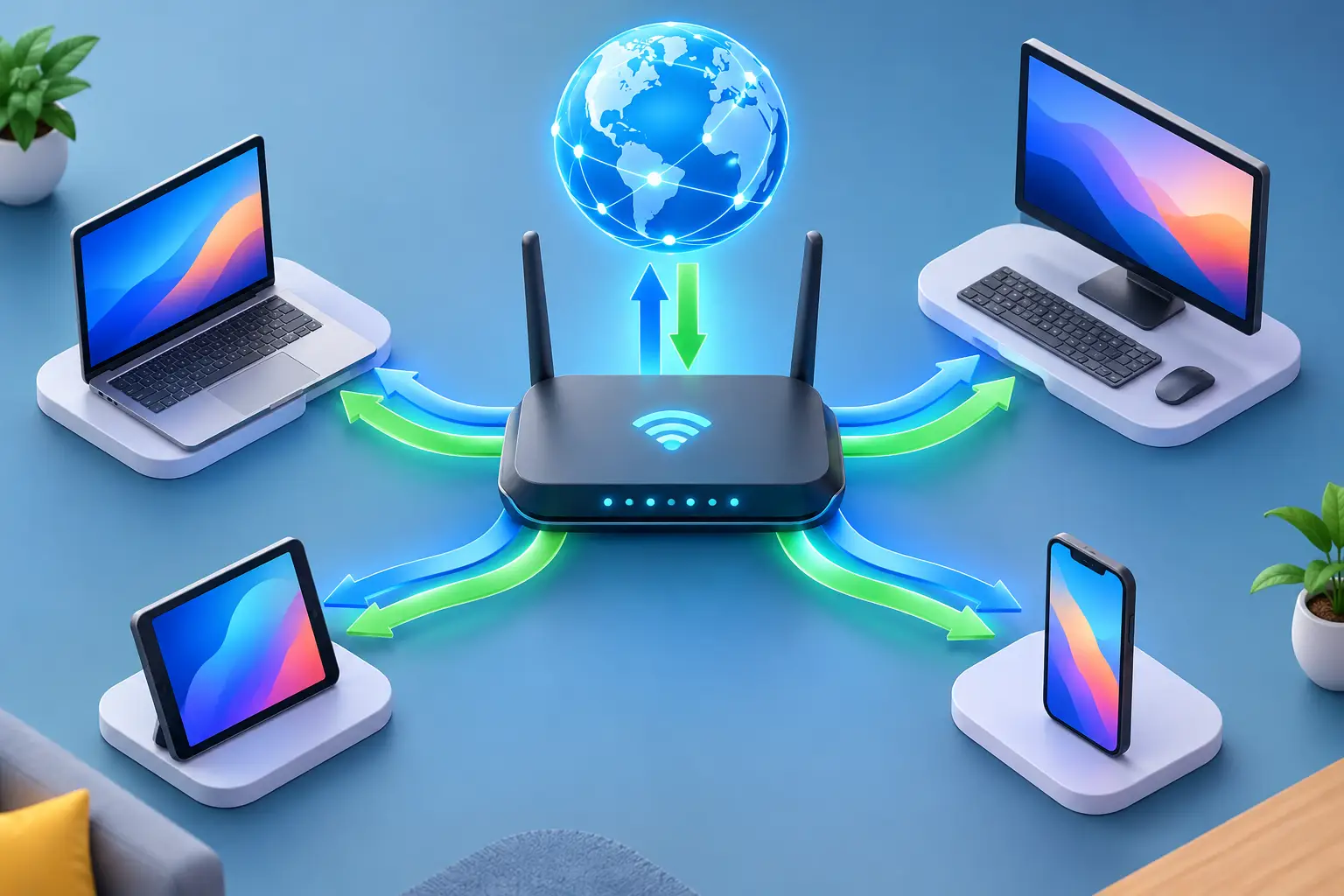
A video call that freezes when someone starts a cloud backup is a familiar frustration in Australian homes and offices. The reason is often upload capacity. So, what is symmetric internet? It is an internet connection where upload and download speeds are the same, or very close to the same.
For example, a 100/100 Mbps service delivers up to 100 Mbps download and 100 Mbps upload. That differs from the more common 100/20 Mbps arrangement, where downloads can reach 100 Mbps but uploads are capped at 20 Mbps. For households that mostly stream, browse and download, that difference may not matter much. For people working from home, creating content, running cloud systems or supporting a busy team, it can change how the connection feels all day.
What is symmetric internet?
Internet speeds are measured in megabits per second, or Mbps. Download speed determines how quickly data comes to you, such as when streaming television, loading websites or downloading large files. Upload speed determines how quickly data leaves your connection, including when sending files, joining a video meeting, backing up devices or publishing content online.
A symmetric connection gives both directions equal capacity. A 250/250 Mbps plan, for instance, is designed to move data in and out at the same rate. This is particularly useful when several people need to upload at once, or when a business relies on cloud-based applications and communications.
The word symmetric refers to the speed profile, not a guarantee that every speed test will show exactly matching figures. Real-world results can vary with Wi-Fi coverage, device performance, network congestion, server capacity and the way a plan is provisioned. Wired testing with a capable device is the best way to understand the performance reaching your premises.
Symmetric internet versus asymmetric internet
Most standard broadband services are asymmetric. They provide higher download speeds than upload speeds because traditional household internet use has leaned heavily towards consuming content. Streaming services, online shopping, web browsing and game downloads all use more download capacity than upload capacity.
That model still suits plenty of homes. A family that watches streaming services in the evening and checks email during the day may see little benefit from paying extra for equal upload speeds. The decision becomes different when upload traffic is constant or business-critical.
Consider two connections with the same 100 Mbps download speed. On a 100/20 Mbps service, a large backup or video upload can occupy much of the available upload bandwidth. Video calls may become pixelated, audio can break up, and sending files to clients takes longer. On a 100/100 Mbps service, those uploads have significantly more room to move.
Symmetric speed does not make every online activity faster. A streaming platform, for example, mainly relies on downloads. It also cannot overcome a slow website, an overloaded application server or poor Wi-Fi in a distant room. Its value is in removing the upload bottleneck that affects modern work, collaboration and cloud services.
Where equal upload and download speeds make a difference
Working from home and hybrid teams
Video calls send and receive data at the same time. If several people in one household are on Teams, Zoom or similar platforms, upload capacity becomes just as relevant as download capacity. A symmetric service gives each person more headroom, particularly when cameras are on and files are being shared during meetings.
It can also help professionals who regularly send design files, videos, CAD drawings, reports or other large documents. Rather than scheduling uploads overnight or pausing other online activity, they can keep work moving while maintaining a usable connection for everyone else.
Cloud backups, storage and security
Cloud storage is often described as a convenience, but for many businesses it is part of their continuity plan. Backing up devices, synchronising shared folders and transferring data to cloud platforms all depend on upload speed.
With an asymmetric service, the first full backup can take a long time, especially where there is a large volume of business data. Subsequent backups are usually smaller, but regular uploads still compete with everyday traffic. Symmetric internet can shorten those transfer windows and make cloud-first workflows more practical.
Content creation, gaming and connected homes
Creators uploading high-resolution video, photographers sending galleries and streamers broadcasting live can all benefit from stronger uploads. Gamers should be aware that online gaming itself does not usually need huge upload speeds. Low latency, stable routing and a reliable local network often matter more. However, uploading gameplay, live streaming and having multiple users online at home can justify extra upstream capacity.
Smart cameras, doorbells and other connected devices also upload data. A few devices are unlikely to require a symmetric service on their own, but a larger setup with security cameras recording to the cloud can add meaningful upload demand.
Businesses with cloud phones and multiple sites
For a business, internet is not just a way to browse. It may carry cloud phone calls, point-of-sale traffic, customer service platforms, backups, remote access and connections between locations. Equal upload and download speeds can provide more predictable capacity when staff are simultaneously speaking with customers, sending documents and using cloud applications.
That said, bandwidth is only one part of a dependable business connection. A professional solution may also need prioritised voice traffic, managed firewall protection, a backup service, static IP addressing or SD-WAN for multiple locations. The right design depends on how costly an outage or performance issue would be for the organisation.
Can you get symmetric internet in Australia?
Availability depends on the network serving your address and the product available there. Some fibre-based services can offer symmetric speed tiers, while others have asymmetric upload limits even on fast download plans. Enterprise Ethernet and private fibre services are commonly designed with equal speeds and dedicated business requirements in mind, but they are not the same as a standard residential broadband plan.
On the NBN, the technology at a premises matters. Full fibre connections generally offer stronger potential for high upload speeds than older technologies, although the plans a provider can offer will still vary. OptiComm estates, private fibre networks and fixed wireless solutions each have their own speed profiles and availability rules.
It is worth checking the actual upload speed shown for a plan rather than assuming that a high download figure includes high uploads. A plan labelled 250 Mbps may be 250/25, 250/50 or 250/250 depending on the service. Those are very different options for a team that sends large files every day.
How to choose the right speed profile
Start with the activities that happen at the same time, not just the number of people connected. A household with four people casually browsing may need less capacity than two people regularly running video calls and uploading work files. Similarly, a small office with ten staff may need more than a faster download plan if its cloud applications and phone system depend on reliable upstream traffic.
Look at your current usage during busy periods. Slow uploads, delayed file syncing, dropped call quality and security camera footage that takes too long to upload are practical signs that your upload speed may be too low. If Wi-Fi is the issue, moving closer to the modem, using Ethernet for fixed devices or improving wireless coverage may solve the problem without changing the internet plan.
Also consider whether you need consistently high uploads or occasional bursts. A creator who uploads large projects every week may benefit greatly from symmetry. A household that only sends a large photo album a few times a year may be better served by a reliable asymmetric plan with sufficient upload capacity.
Is symmetric internet worth it?
Symmetric internet is worth considering when upload performance is directly tied to your work, communications or data protection. It is especially valuable for hybrid workers, cloud-reliant businesses, content creators and organisations operating voice, security or multi-site systems over the connection.
For simpler household use, an asymmetric plan can remain an efficient and cost-effective choice. The best service is not necessarily the one with the largest numbers on the page. It is the one that supports your busiest hour without forcing people to stop what they are doing.
Before choosing a connection, check what is available at your address, compare both upload and download figures, and think about the services your household or business will rely on next year as well as this month. A connection with the right upstream capacity gives people room to work, communicate and protect their data with greater confidence.