
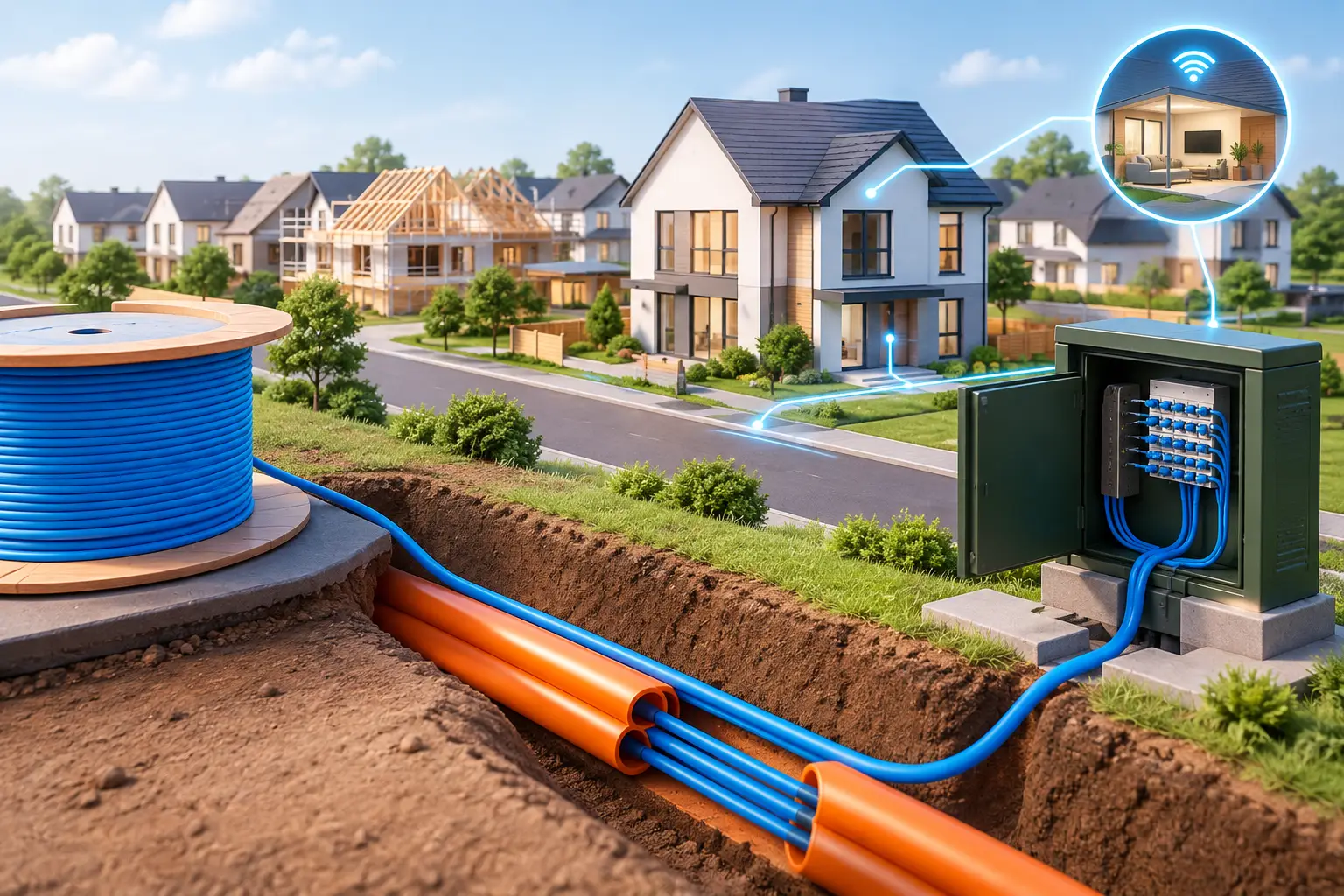
A missed conduit under a driveway can turn a straightforward fibre connection into an expensive civil works job. For developers, internet planning is not a finishing touch once tenants or buyers are ready to move in. It is core building infrastructure, alongside power, water and drainage.
This developer fibre network guide explains what Australian developers need to consider when planning fibre for a new estate, commercial development or multi-dwelling building. The right approach gives future occupants access to dependable broadband, protects the project programme and avoids last-minute compromises that can affect saleability, leasing and business operations.
Start fibre planning before detailed design
The best time to make connectivity decisions is during early civil and services design. By then, the development footprint, lot layout, building locations and service corridors should be clear enough to identify a practical network path. Leaving it until construction is underway can mean reopening finished surfaces, negotiating around other utilities or accepting a less suitable connection location.
Start by establishing what type of project you are delivering. A small greenfield subdivision, a mixed-use precinct, a warehouse complex and an apartment building each have different pathways, network ownership arrangements and capacity needs. The number of premises matters, but so do the expected users. A medical centre, for example, may need greater resilience and business-grade support than a similarly sized retail tenancy.
Availability is also location-specific. Depending on the site, the appropriate access network may involve NBN infrastructure, OptiComm, another wholesale network, private fibre or a combination of services. Regional and remote projects may need fixed wireless or satellite as part of the connectivity plan. Do not assume the service used in a neighbouring street can simply be extended to the new development.
Early engagement with a capable provider helps translate the development plan into a workable connectivity strategy. InfiNET Broadband can assist developers and businesses that need to consider both everyday broadband requirements and higher-level private fibre or enterprise networking needs.
Developer fibre network guide: map the physical pathway
Fibre service is only as practical as the pathway that gets it from the network boundary to each premises. This is why pit and pipe design deserves the same attention as visible building services. A well-planned pathway makes installation, testing, maintenance and future upgrades much easier.
The design should account for the likely point of interconnect, lead-in routes, pits, conduits, building entry points and internal risers where relevant. On a multi-storey building, the pathway also needs to support distribution from the communications room to each floor or tenancy. In a business park, it may need to allow separate connections for multiple occupants without repeated excavation.
Conduits should be sized and routed with future use in mind, not just the first connection. A route that is technically adequate today may be difficult to use if it has too many bends, becomes congested with other services or cannot be accessed for repair. Installing spare capacity during civil works is generally far more economical than digging up landscaped areas, car parks or finished roads later.
Keep fibre separate from assumptions
A common project risk is assuming another contractor is handling the communications component. Civil contractors may install conduits, electricians may fit internal communications cabinetry, and builders may provide risers, but those works need to align with the network provider’s requirements and the overall connection design.
Document responsibility clearly. Confirm who supplies pits, who installs conduit and draw ropes, who manages inspections, and who arranges the final service connection. This avoids a familiar handover problem: a completed building with no compliant route for fibre to enter it.
The exact specifications can vary by network and development type. Always work to the applicable network design rules, construction standards and local approval requirements rather than relying on a previous project’s details.
Choose connectivity for the people using the site
For residential developments, buyers and tenants increasingly expect fast, reliable internet for streaming, gaming, remote work and connected home devices. Unlimited data plans and flexible service options can be a meaningful selling point, particularly where mobile coverage is variable.
Commercial developments require a broader conversation. A café may primarily need dependable EFTPOS and guest Wi-Fi, while a professional services firm may rely on cloud applications, video meetings, VoIP and secure remote access all day. Businesses with several locations may benefit from managed networking, SD-WAN, cloud phone systems and security services alongside their internet connection.
Private fibre can be worth considering where a site has high bandwidth requirements, needs a dedicated connection, operates critical systems or requires a direct link between buildings. It is not automatically the right choice for every development. The trade-off is usually higher upfront design complexity and cost in return for greater performance control, capacity and business continuity options.
For larger sites, ask practical questions early:
- How many premises need an independent service, now and at full build-out?
- Will any occupier need enterprise ethernet, a dedicated fibre service or multiple connections?
- Where will communications equipment be housed, powered and protected?
- Does the project need a backup connectivity path for critical operations?
These answers influence the physical design as well as the service provider conversation.
Design the building side properly
A fibre network does not end at the external boundary. Internal building design determines whether occupants can use the service effectively once it arrives. For commercial premises, this includes a suitable comms room or cabinet, ventilation where equipment requires it, secure access, reliable power and room for patching and future hardware.
For apartment developments, risers and telecommunications cupboards need enough space for distribution equipment and safe technician access. Poorly located or undersized cupboards can create ongoing maintenance issues long after practical completion. They can also make it harder to add services for new residents or building systems.
Consider Wi-Fi separately from the incoming fibre service. Fibre may provide excellent capacity to the building, but coverage inside a large home, office, warehouse or concrete apartment complex depends on router placement, access point design and local network equipment. Developers of premium residences, serviced offices and managed sites should plan for this distinction rather than promising a whole-building result from one connection point.
Build in resilience where downtime costs money
Not every site needs redundant fibre, but every business-focused development should assess the cost of an outage. A short interruption may be inconvenient for a small office. For a site running payment systems, security cameras, cloud-based phones, access control, dispatch or customer-facing digital services, it can quickly become a trading problem.
Resilience can take different forms. A second service delivered through a diverse path offers stronger protection than two services that share the same physical route. A fixed wireless or mobile backup may be suitable for less critical continuity needs. Managed firewall and network configurations can also help businesses fail over to a backup service with less manual intervention.
The right option depends on risk, budget and the work performed at the site. It is better to make that decision during design than to discover the need after the first outage.
Treat handover as a connection milestone
Practical completion does not always mean a site is ready for internet activation. Before handover, confirm that pathways are complete and accessible, required network documentation has been supplied, communications rooms are ready, and addresses are correctly recorded for service ordering.
Allow realistic lead time for final installations. Connection timing can be affected by construction readiness, network approvals, technician availability and whether any defects need rectification. For staged projects, plan each release separately so early occupants are not waiting on infrastructure intended for a later stage.
A good handover pack should give the owner, strata manager or facilities team a clear record of communications assets, equipment locations, pathway drawings and provider contacts. This is particularly valuable when a fault occurs years later and the original project team has moved on.
Fibre is a long-life asset. When it is planned early, built with accessible pathways and matched to the needs of future occupants, it supports a better property experience from day one. That is the kind of detail buyers, tenants and businesses may not notice at inspection, but they will certainly notice when it is missing.