
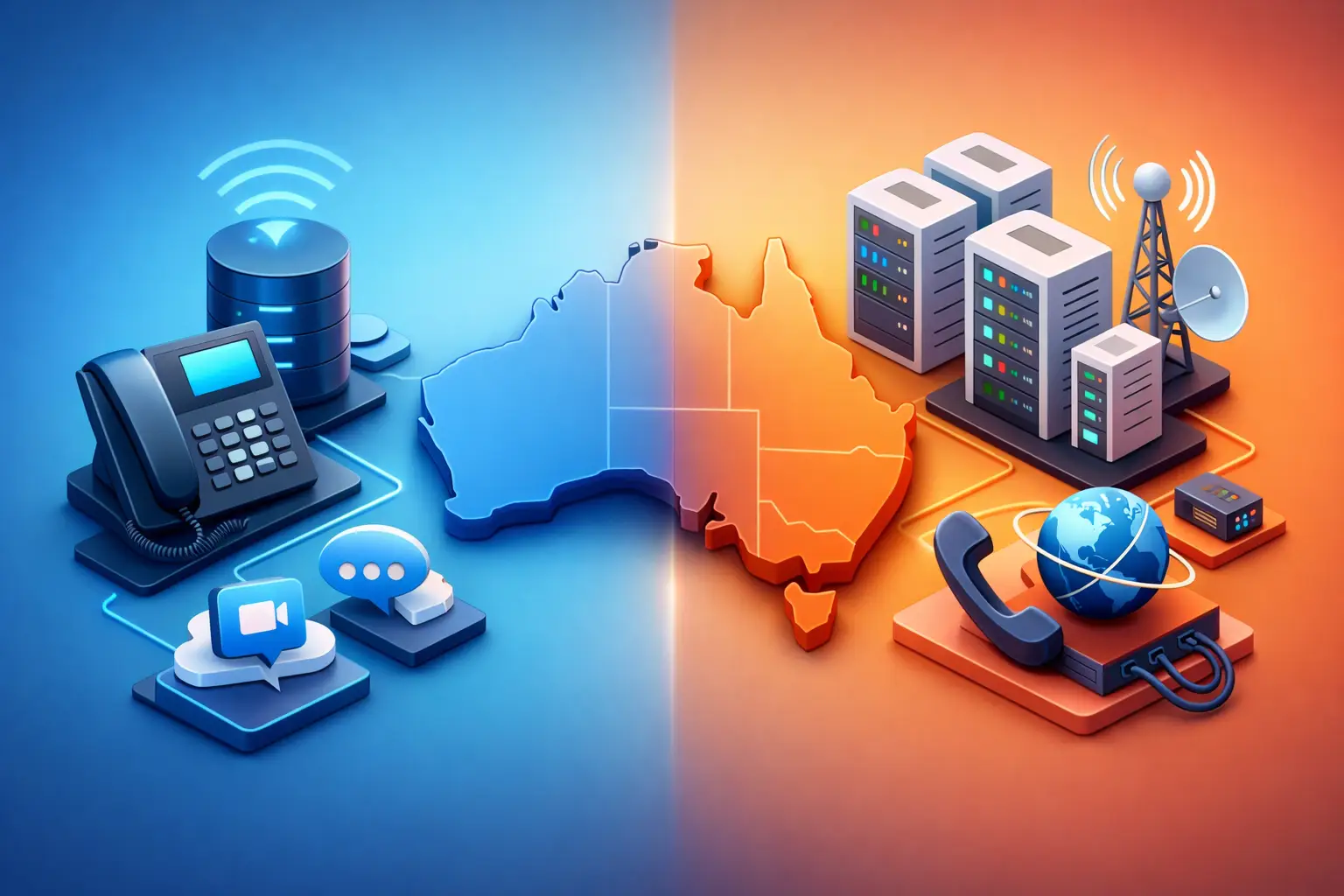
A receptionist answers calls through a cloud phone app. A warehouse keeps its existing PBX but adds ten new lines for a busy season. Both businesses use internet-based calling, yet the right service is different. That is why VoIP vs SIP trunks is not really a contest. It is a decision about how your business wants calls to travel, where your phone system lives and how much control you need.
For Australian businesses, the practical question is not which term sounds more advanced. It is whether you need a complete phone system, a connection for an existing one, or a mix of both. Get that right and your team can communicate clearly across offices, home locations and mobiles without paying for capacity it does not use.
VoIP vs SIP trunks: the key difference
VoIP, or Voice over Internet Protocol, is the broad technology that carries voice calls over an internet connection rather than a traditional copper phone line. It can describe many services, from a simple business phone app to a fully hosted cloud PBX with call queues, voicemail-to-email, auto attendants and video meetings.
A SIP trunk is more specific. It is a virtual connection that uses the Session Initiation Protocol to link a business phone system – usually an on-premises PBX or IP-PBX – to the public telephone network. Think of it as the digital equivalent of a bundle of phone lines, except capacity can be configured to support the number of simultaneous calls your business requires.
In short, SIP trunks are one way to deliver VoIP calling. A business can use VoIP without buying SIP trunks, particularly when it uses a hosted cloud PBX. It can also use SIP trunks to keep an existing phone system while replacing older ISDN or analogue services.
That distinction matters because a cloud phone system and a SIP trunk solve different problems. One provides the phone platform and its features. The other provides the calling path for a phone platform you already own or manage.
When a hosted VoIP phone system makes sense
Hosted VoIP is often the straightforward choice for small and mid-sized businesses that want modern phone features without maintaining PBX hardware in the comms room. The provider hosts the platform, while staff use desk phones, softphones on their computer or an app on their mobile.
This setup suits a growing accounting practice, a trades business with staff regularly off-site, or a retailer that wants calls to ring several locations before going to voicemail. Adding a new user is generally easier than installing another physical line, and staff can often keep working from another location if the office is inaccessible.
The main benefit is simplicity. Rather than managing a PBX, software versions and carrier connections separately, your business receives an integrated calling service. Features such as business hours rules, hunt groups and call reporting are usually managed through a portal or with help from your provider.
Hosted VoIP also works well where flexibility matters more than preserving existing hardware. If your team is largely mobile or hybrid, a phone number that follows the user can be more valuable than a fixed handset at every desk.
There are trade-offs. Your options may be shaped by the hosted platform’s feature set, integrations and handset compatibility. Very large contact centres, organisations with specialised call routing or businesses with heavily customised legacy systems may need more control than a standard hosted service provides.
When SIP trunks are the better fit
SIP trunks are usually a strong option when a business already has a capable PBX and wants to retain it. This may be an on-premises IP-PBX at a main office, a multi-site system with established call flows, or a platform integrated with door access, paging, CRM software or contact centre tools.
Instead of replacing the system, SIP trunks connect it to external phone numbers and enable inbound and outbound calls. Capacity is based on concurrent calls, not simply the number of extensions. A business might have 80 employees but only need 20 simultaneous call paths, depending on its calling patterns.
This model can offer meaningful control. Your IT team or managed provider can configure routing, failover rules, number presentation and site-level requirements around the PBX. It can also be a practical path away from legacy voice services where compatible equipment is already in place.
However, the business remains responsible for more of the overall solution. That includes the PBX, compatibility, licensing, security settings and, in many cases, ongoing technical management. SIP trunking is not automatically cheaper if aging hardware needs replacement or specialist support to keep it operating reliably.
Start with your phone system, not the price list
Comparing monthly call costs alone can lead to the wrong decision. Start by mapping what happens when someone calls your main number. Where should the call go? What happens after hours? Do teams need shared queues, recordings, reporting or integrations? Are staff working from home, in vehicles or across several sites?
Then consider what you already have. If your PBX is reliable, compatible and central to the way your organisation operates, SIP trunks may extend its useful life. If it is expensive to maintain, difficult to support or unable to meet the needs of a mobile workforce, moving to hosted VoIP can reduce complexity.
A few operational questions are worth answering before any change:
- How many concurrent calls occur during peak periods, not just how many employees have a phone?
- Does the business need to keep existing numbers, direct inward dial ranges or specialised call-routing rules?
- Which systems must integrate with telephony, including CRM, alarms, lifts, fax services or door entry?
- Who will manage the PBX, handsets, user access and security once the service is live?
These answers define the solution more accurately than a generic per-user comparison.
Your internet connection is part of the phone system
Internet calling depends on more than download speed. Voice is sensitive to latency, jitter and packet loss. A connection that handles web browsing perfectly well can still produce choppy calls if large uploads, cloud backups or guest Wi-Fi traffic compete with voice traffic.
For a small office, a quality NBN or business-grade connection with sensible network configuration may be enough. For larger sites, private fibre, enterprise ethernet or a dedicated business service may provide the performance and service assurance required for critical calling.
Quality of Service settings can prioritise voice traffic on the local network, helping calls remain clear when other applications are busy. Properly configured routers, managed switches and business-grade Wi-Fi also matter. Plugging new handsets into an overloaded office network and hoping for the best is not a continuity plan.
Resilience deserves the same attention. If the primary connection fails, can calls divert to mobiles, another site or a secondary internet service? Multi-site organisations may use separate connections and routing policies to avoid one outage taking every phone offline. In regional and remote locations, fixed wireless or satellite can support voice services, but the design should account for available capacity and latency.
Security and emergency calling need clear ownership
VoIP systems are connected services, which means they need the same care as other business technology. Weak passwords, exposed PBX settings and poorly controlled user access can create risks such as toll fraud or unauthorised calling.
Use strong credentials, limit administrator access, keep PBX software current and review international calling permissions where appropriate. A managed firewall and monitoring can add another layer of protection, particularly for organisations operating their own PBX and SIP trunks.
Emergency calling should also be planned rather than assumed. Confirm how 000 calls are handled, which address information is associated with each service and what occurs during a power or internet outage. Staff should know the backup process, especially at sites where mobile coverage is limited. This is a practical requirement for every business phone deployment, whether it is hosted VoIP or SIP trunking.
Choosing a provider that can support the full picture
The right provider should look beyond the number of channels or user licences. They should ask about your existing equipment, internet connection, peak calling load, remote workforce and failover requirements. That approach helps prevent a service that works on day one but becomes difficult to scale or support later.
For many businesses, there is value in having connectivity and voice considered together. InfiNET Broadband can support business internet and phone requirements as part of a wider connectivity plan, with local Aussie support available when the issue crosses from the handset to the network.
Before you change anything, document the calls your business cannot afford to miss. That simple exercise will make the choice between hosted VoIP and SIP trunks far clearer, and help build a phone service that keeps your people reachable when it matters.